

The Simple Question that Could Reshape Your Life
During Life Transitions, We Change How We View the Shape of Our Life

My new book A TIME TO GATHER: How Ritual Created the World—and How It Can Save Us will be published on May 19. Pre-order is available today wherever you get your books. Thank you!
What if I told you that there is a simple question that could reshape how you view your life?
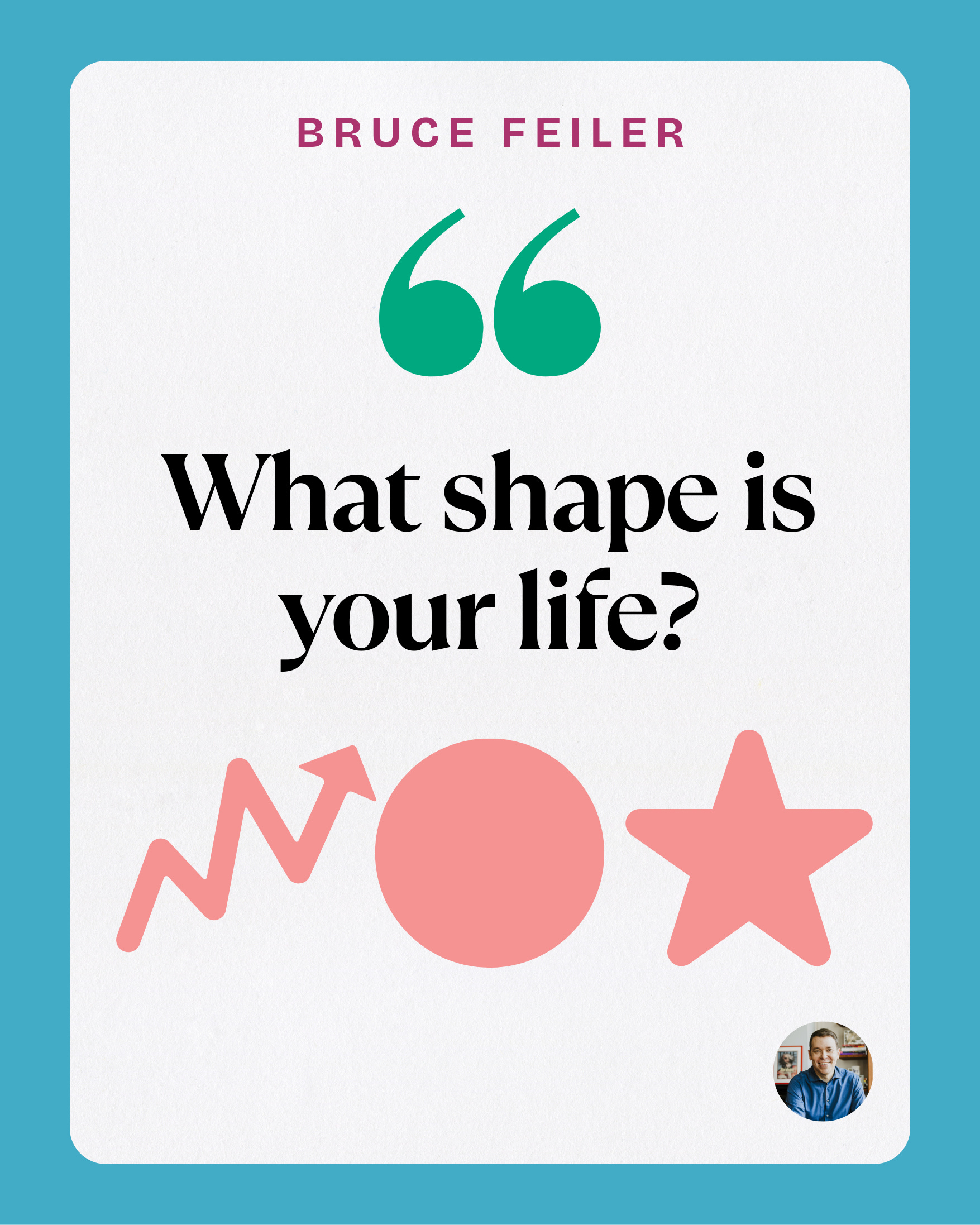
About ten years ago I began asking people a simple question: “What shape is your life?” At the time I was reading about the science of chaos and noticed that researchers trying to capture the world as it really is kept circling back to shapes.
The turbulence in water generates complex dimples and swirls; clouds drift in and out of tufts and puffs; the perimeter of a country appears from above as the familiar outline you see on a map, but the closer you get, the more you see an endless variety of juts, bends, coves, and bays.
Chaos theory created an entire new vocabulary of shapes to capture these phenomena: fractals, intermittencies, folded-towel diffeomorphisms, smooth noodle maps, strange attractors, bend curves, spiral vortices, metawobbles, the drunkard’s walk.
[Fun fact: The shape on this list that has had the most meteoric rise to fame is fractals, because it appears in the Disney monocultural phenom “Let It Go.”]
My power flurries through the air into the ground
My soul is spiraling in frozen fractals all around
And one thought crystallizes like an icy blast
I’m never going back, the past is in the past
It was this fascination with shapes in science that first inspired me to ask people what shape best captures their lives. The earliest responses threw me, because they seemed all over the place. They included a house, tree saw, spiral, heart, sunset, winding road, the Brooklyn Bridge, a circle, and, from Brian Wecht, a chaos researcher himself before he jumped to YouTube star, a Calabi-Yau manifold [see below]. This was beginning to seem like a party game with little point.
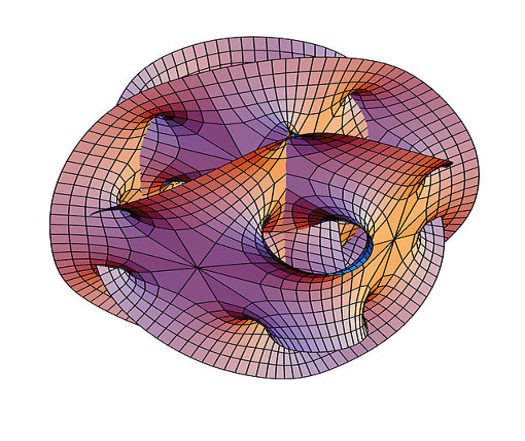
Still, I kept asking, in part because the answers were so vivid, but more because how people explained their answers was so revealing. It was obvious that people had fierce opinions and that their shapes represented something essential about how they viewed themselves. Saying your life is like a stock market chart versus a heart versus Jesus on the cross communicates something powerful about what matters most to you.
But what exactly? I tallied hundreds of answers and determined something surprising.
At a time when the predominant shapes of the past are outmoded—the cycles, staircases, and arrows of progress that once reigned—people’s shapes offer valuable clues about what matters most.
The shapes fall into three buckets:
The first bucket includes shapes that reflect some sort of trajectory. This group said their lives primarily rise and fall, usually in response to their individual success or failure. Examples include a river, winding road, zigzag, or mountain range.
One man I spoke to escaped a challenging family in Georgia, survived a liver transplant, and became an elite book editor in New York. Then, he lost his job and marriage in the same year. “I look at my life narratively, as a line with peaks and valleys.”
Because of the up-and-down nature of these answers, I call this bucket LINES.
As obvious as this shape seems (especially to those who choose it!), it is not the only category.
The second bucket consists of shapes that are more spatial in nature. These shapes are enclosed, with borders, outlines, or walls. Examples include a heart, a house, a basket, a minivan.
One powerful business executive in Los Angeles who gave up her career to raise her children, support her husband, and research her ancestry, said, “I see my life as a house. I hope I’ve made an impact on my community and done good in the world, but ultimately I want to do good for my family.”
Given the way these shapes suggest assembling people, I label this bucket CIRCLES.
The final bucket includes shapes that are some sort of object — a symbol, an icon, a logo. Examples include a light bulb, a cross, a butterfly, an infinity sign.
One activist who started to two nonprofits told me, “I’m a fighter, so my shape is boxing gloves. I’ve always been pushing boundaries around gender or religion.”
I tallied up all the answers and broke them down by group.
Half of people fell into the first category; their shape is a LINE.
Two in ten chose a CIRCLE.
Three in ten chose a STAR.
I wanted to understand what these shapes represent, so I dug deeper. Here’s what I discovered.
The people who choose lines tend to focus on agency—what they build, make, or create. The shape of their life is their work.
The people who choose circles tend to prioritize belonging—their family, their coworkers, their community. The shape of their life is defined less by their achievements and more by their relationships.
The people who choose stars tend to prioritize causes—their purpose, their passion, their service. The shape of their life is defined by what they believe in.
But here’s the key.
Just because a person picks one shape doesn’t mean they don’t value the others. We all have multiple sources of identity. We have different shapes. What it does suggest, I believe, is that we foreground one of these shapes during certain times of our lives.
We shape-shift.
We’re all familiar with this idea in our own lives. We can name people who build their identity around their work, or who sacrifice their own ambitions to raise children or care for a sick relative, or who eschew careers with high financial return in favor of teaching school, spreading the gospel, or saving the environment.
What we’ve yet to fully appreciate, I believe, is that making this choice means we prioritize a different pillar of meaning, we emphasize a different personal story, and we prize a different life shape. In effect, we all have all three shapes in our minds and at different times in our lives we foreground different ones.
In other words, the meaning we take from our lives is not static or stable. It fluctuates, it oscillates, it ebbs and flows.
This change of direction often happens when we hit a lifequake or go through a life transition. When our life changes or our priorities change.
And our dominant shape changes as well.
So as we start off this year, ask yourself a simple question:
What shape is my life?
Your shape is like a reality check of what’s most important to you at this moment. But it’s also a reminder that even as you focus on your primary shape, you can still do something to cultivate the other shapes in your life. So you might want to identify those shapes, too.
Because sometime soon, you might want to shape-shift again.
🌞
Thank you for reading The Nonlinear Life. This is a reader-supported newsletter. You can support my work by pre-ordering a copy of A Time to Gather or any of my other books. Click on the photo below to learn more.

Meanwhile, help us grow our community by subscribing, sharing, and commenting below. And
you might enjoy reading these posts:
My TED Talk: How to Master Life Transitions
The Stories That Bind Us: My Most Popular Piece Ever
Why You Should Fight About Money With Your Family
Or, you can contact me directly.
How would you categorize a spiral or gyre? I see repeating themes, but always in wider context or application.