

Collective Transitions Are Growing. Here's How to Navigate Them.
Why Going Through Change with Others Can Help—and Why It Can Hurt

I’m thrilled to announce that for the first time ever I’m partnering with Greenlight Bookstore in Brooklyn to offer signed personalized copies of my new book, A TIME TO GATHER: How Ritual Created the World—and How It Can Save Us. Please join me in supporting independent bookstores—and help us build momentum—by ordering your exclusive copy or copies today. On sale date is May 19. Thank you!
The number of collective life transitions is higher than it’s been at any point this century. Here’s what’s positive about this dizzying development—and here’s what to be wary of.
Last week someone sent me an email that I thought was so on point that I decided to answer it in this forum. The email also gets at a question I’ve been mulling for the last few years.
A little context before I quote the note and share my response.
My decade-long work analyzing life stories has focused on the idea that we go through three to five lifequakes in the course of our adult lives. A lifequake is a forceful burst of change that leads to a period of upheaval, transition, and renewal.
But not all lifequakes are the same.
I divide lifequakes along two axes—voluntary and involuntary; personal and collective.
A voluntary lifequake means that the person initiated the change (getting married, switching jobs, changing religions), while involuntary means that the lifequake happened to you (you get a diagnosis, your house burns down, you’re fired). An involuntary lifequake is your spouse cheats on you; a voluntary lifequake is you cheat on your spouse.
Forty-three percent of our lifequakes are voluntary, 57 percent involuntary.
A personal lifequake means that something happens to you individually (a career change, a health crisis, losing your home), while a collective lifequake is an event that happens to you along with many others (a recession, a war, a natural disaster, a pandemic). I found that 87 percent of lifequakes are personal, 13 percent collective.
I then layered these two axes on top of each other and created what I call the lifequake matrix, which appears in my book Life Is in the Transitions.
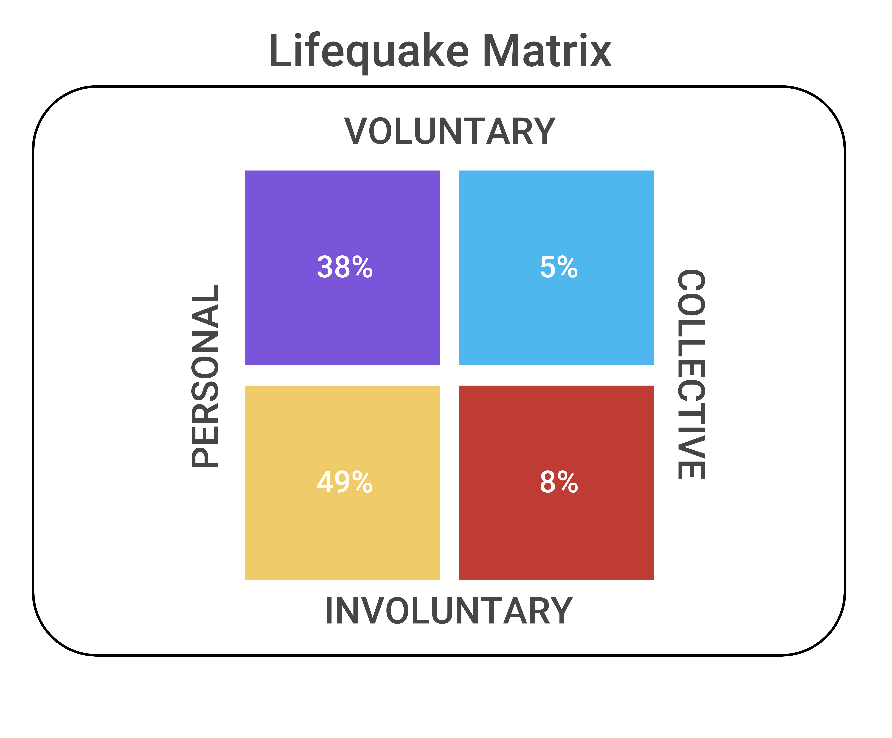
An undeniable headline from this matrix is that collective life transitions are extremely rare. In my book, which I completed in 2019, I make the following observation:
Had I done these interviews in the twentieth century, with its back-to-back wallops of two world wars, the Great Depression, civil rights, and women’s rights, surely the number of collective events would have been higher.
But then my book was published in the middle of a global pandemic, when the entire planet was in the same collective, involuntary lifequake at the same time for the first time in nearly a century.
And that collective involuntary lifequake wasn’t the only one of this decade. We’ve since had massive political destabilization around the globe, widespread mental health challenges stemming from digital technology, and here comes AI.
Could it be that collective, involuntary lifequakes are actually speeding up?

That question brings me to the email I just received from a doctor who’s finishing a book about physician retirement. Here’s the relevant section:
Certainly, the transition from practice to life after medicine is a lifequake for most. It sits in the personal voluntary quadrant of your matrix - unless a personal health issue or bad outcome shoots them out of the saddle.
Looking at the numbers in the four quadrants and thinking about the chaos of today’s environment in the USA - do you believe the numbers in the collective quadrants are higher now... people being forced to change/adapt as a society/culture/ collective more now... especially since Trump’s election??
I’m seeing a lot of doctors not retiring because of the collapse of the U.S healthcare system and their own survivor guilt and shame.
They’re struggling to create their own personal lifequake and a societal lifequake is making things even worse - delaying them taking the healthiest option.
First of all, thank you for the question—and for all questions and comments that come through this newsletter, social media, or my website.
Second, yes, I do think we’re in the midst of a massive collective involuntary life transition. I’d say it’s the first mass one that Americans, at least, have experienced since 9-11. And like that event, I also think that this collective involuntary transition proves a number of ideas that appear in Life Is in the Transitions, while also raising new ones.
The point that I believe my research anticipates is the idea that transitions take, on average, five years. This number often shocks and dismays people. Wait, I’m feeling miserable enough as a result of my divorce. Now you’re telling me that I’m going to feel this way for five years!
No, I’m not saying that. What I’m saying is that people self-report that the transitions that they go through don’t fully resolve themselves for an average of five years. But that self-reporting does not necessarily mean that they feel the same degree of misery for all five of those years. Just as life is nonlinear, life transitions are nonlinear.
The reason the length of transitions is relevant here is because not a day goes by when we don’t learn something about the impact of the pandemic, even though the precipitating event began more than six years ago at this point. We now know that the pandemic changed eating habits, dining out habits, work habits, travel habits.
A big theme in the book I’m releasing this spring, A Time to Gather, is that the loneliness and isolation of quarantine was big a big boost to the explosion of new rituals around the world that I’ve been reporting on for the last three years. Old rituals are being changed—weddings have gotten smaller, for example, while funerals have become even rarer as cremation has spiked above 50 percent of deaths.
(PS: Someone asked me this week what my favorite experience was during the research for this book in sixteen countries. My answer: attending ten funerals in a week in Ireland, including my first visit to a embalming lab and a crematorium.)
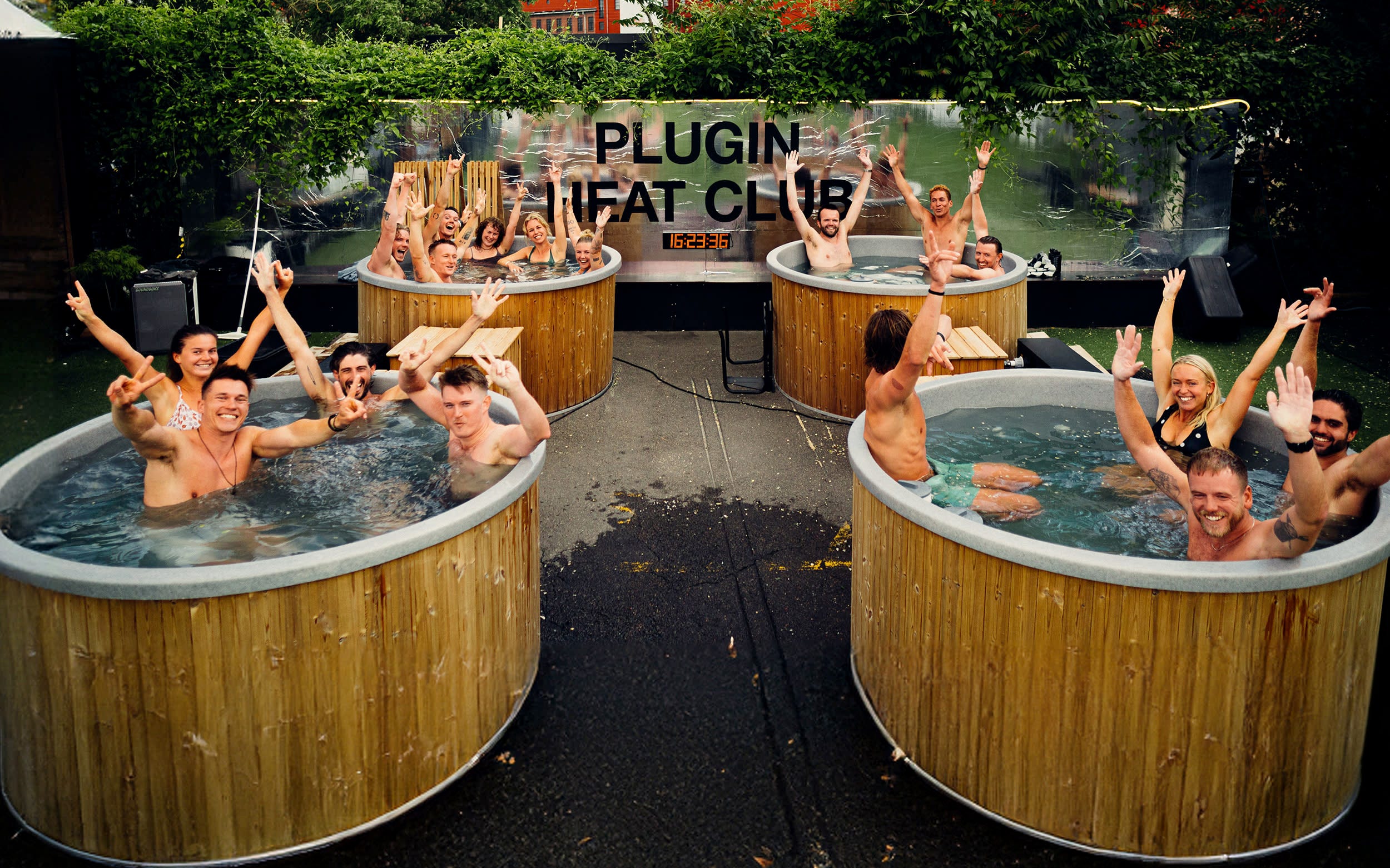
But the pandemic also created swarms of new rituals, from block parties, to grieving and weaving circles, to an explosion in sauna culture.
The New York Times has a story today called “Putting on the Shvitz” about a sauna fest in Brooklyn; the photo below is from my visit to a trendy sauna-and-cold-plunge total pickup scene in Copenhagen in which I squeezed mostly naked into a sauna, then dunk myself in a cauldron of ice soup, with a bunch of people who were all younger, hotter, and more tattooed than I am. (Not hard, I admit!)
But back to the larger point.
A clear advantage of collective involuntary lifequakes is that everybody knows that everybody else is going through the same difficult time together. You don’t have to be ashamed or embarrassed or even particularly reticent to say to someone at the grocery store or in the elevator that times are confusing and tough. I don’t know about you, but nearly every conversation I have with someone I haven’t seen in a while spends at least some time acknowledging that these are weird times we’re all living through.
But that advantage is not without complications. A clear disadvantage of collective involuntary lifequakes is that we assume we know what others are going through. And yet we don’t. One consequence of that five-year number is that it takes time for these events to play out in our lives.
Again, just think of the pandemic: some people coupled up during that time, others broke up; some people moved to be closer to family and friends, others moved to be away from people in more isolated areas; some people ordered more takeout, others did more cooking (remember all that sourdough!).
These varied responses hold an important reminder: just because you think you know what others are going through, you probably don’t.
So, my advice about this and so many other situations involving life transitions: ask before you advise. And if you’re the one being asked, share with people what you’re going through and don’t expect them to be able to guess.
The point is, even collective transitions are ultimately individual in their impact. As my emailer wrote, personal lifequakes and societal lifequakes become intertwined, allowing everyone to move all at once in directions entirely unique to our lives.
🌞
Thank you for reading The Nonlinear Life. This is a reader-supported newsletter. You can support my work by pre-ordering a copy of A Time to Gather or any of my other books. Click on the photo below to preorder today.

Meanwhile, help us grow our community by subscribing, sharing, and commenting below. And
you might enjoy reading these posts:
My TED Talk: How to Master Life Transitions
The Stories That Bind Us: My Most Popular Piece Ever
Why You Should Fight About Money With Your Family
Or, you can contact me directly.