

3 Things Taylor Swift Gets Right About Modern Weddings—and One Thing She Gets Wrong
What the Ritual of the Century Tells Us About the State of Our Union on Our 250th Birthday

I’m thrilled to share that I’m leading my first-ever, four-day, in-person course on finding meaning in times of change. I’ve partnered with Chip Conley and the great folks at Modern Elder Academy for a once-in-a-lifetime opportunity in the hills of Santa Fe. Spots are strictly limited and you can save 10% if you order by July 15. I hope you’ll join us!

The New York Times, New York Post, and TMZ all agree, so it must be true: Taylor Swift and Travis Kelce are getting married in New York City in coming days as part of the biggest weekend of the decade. In a three-day span, The City That Never Sleeps will see a sleepless orgy of once-in-a-life time rituals—America 250, the World Cup, and a Royal Wedding of the Queen of Breakups and the Dude in the Bucket Hat Cameo from Happy Gilmore 2.
In my lifetime, Charles and Diana’s loveless vows in 1981 are the benchmark of irrational exuberance around rituals: $50,000 dress! Ten thousand pearls! Twenty-five-foot train! Five-tier cake (with twenty-seven backups in case of accidents)! And most important: 750 million viewers worldwide.
Taylor + Travis will have—well, I don’t know, beyond the small detail that they’ve rented out Madison Square Garden and effectively promised to fill it with more celebrities than the Knicks. Beyond this gobsmacking tidbit, I’m not allowed to tell you, or I’ll risk forfeiting my invitation that is somehow still lost in the mail.
But what I can tell you having spent the last few years attending countless weddings around the world—along with the six I did count, all in one day in Las Vegas—is that spectacles like this one often help reshape our view of rituals like marriage.
Here are three things the Taylor Swift and Travis Kelce wedding gets right about love rituals today—and one thing it gets wrong.
1. We Are Starving for Modern Rituals Around Love
As we all know by now, marriage is in free fall. In 1960, 95 percent of American over forty had married at least once; four in ten Americans told surveyors that anyone who remained single was “sick,” “neurotic,” or “immoral.” Today, the percentage of American adults who are married dipped below 50 percent for the first time. Most of us are immoral!
On the one hand, it’s easy to be skeptical that one celebrity has the ability to change such a large-scale social trend like the decline of matrimony. But look at what this celebrity did for breakups: She turned her heartbreaks into a billion-dollar brand.
One of the most popular chapters in my new book, A Time to Gather, is “The Taylor Swift Divorce Party,” which tells the story of a woman on Long Island who created the world’s first divorce registry after her marriage fell apart. In an attempt to draw even closer to her friends, she wrote a blog post about how to host a Taylor Swift-themed divorce party.
Taylor Swift’s music resonates with themes of resilience, self-discovery, and empowerment, making it the perfect inspiration for a celebration of newfound independence.
The planner included “Shake It Off” cocktail mixers, “Blank Space” cupcakes, and “Love Story” cake pops. “Raise a toast with ‘Red’ sangria,” and dance to “We Are Never Ever Getting Back Together.”
That this bard of breakups is now hosting what appears to be the most lavish public wedding celebration since Sly Sloan also got married in the world’s most famous arena in 1974 is a reminder of something Esther Perel once told me about relationships: “The people who get divorced are the most romantic. They still believe in the ideal of marriage but think that they just picked the wrong person.”
[The incomparable Esther Perel just hosted me for a conversation about the importance of ritual; you can watch our conversation here.]
Whatever happens, the wedding of the century on the weekend of the semiquincentennial is a reminder that love rituals aren’t going away entirely this century, even if they’re under rapid reinvention.
2. Rituals Are Occasions for Connection, Bonding—and Gossip
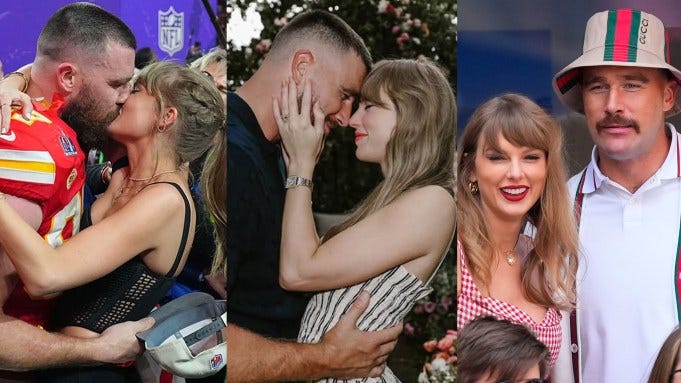
One thing we know about Swifties is that they love looking for Easter eggs. Every song, graphic, post, and outfit is scrutinized for a Rosetta Stone of Taylor Tao. Which is why it was no surprise that the images of her engagement to Travis Kelce were so scrutinized. The #1 conclusion: Taylor had gone #tradwife.
The flowers:
The engagement photos were set in a leafy bower festooned with pink and white roses, anemones, lilies and delphinium, like something straight out of an enchanted garden… The couple are framed beneath an arch dripping in blossoms and flanked by two large white urns overflowing with more floral bounty, as though nature itself had burst into bloom to celebrate the Swift/Kelce union.
The dress:
This fit-and-flare midi has the vintage aesthetic Swift loves without veering into Disney-princess territory, and that’s a win. It’s simple, sophisticated, and the perfect choice for such a momentous occasion.
The ring:
The diamond looked to be an 8-10 carat vintage stone, which is “quite rare” for an antique piece. Jewelry journalist Rachael Taylor said the softer sparkle on the stone was likely because it was an antique cut by hand rather than by machine. She added that Swift’s ring plays into a trend towards vintage styles with different cuts and oversized stones, which fits into the singer’s “romantic” aesthetic.
Even the album that followed the news:
My biggest gripe with Taylor Swift’s The Life of a Showgirl is that she promised us an album that reflected her “exuberant and electric and vibrant” inner and backstage life while traveling the world on her record-smashing Eras Tour. Instead, we got a soulless and incoherent album about Travis Kelce’s “manhood,” featuring another metaphor for what the sky looks like when you’re in love. My second biggest gripe? Taylor’s tradwife lyrics.
The fact that this chatter happened on the internet may be new, but the fact that it happened at all is not new. Weddings have always been occasions for public discourse: “There is no occasion for a feast that is as conspicuous and much discussed as a wedding,” Plutarch wrote. And they’re not alone among rituals—the same goes for funerals, retirement parties, gender reveals, and mom proms.
If anything, these discussions are part of the point—they are a primary means of connection. Once thing I learned reading 500 academic studies about rituals over the last few years is that they strengthen families, neighborhoods and groups of all kinds. A big way they do this is by giving us all something to talk about.
As I wrote in the New York Times years ago, the English word “gossip” grows out of the medieval tradition that parents and godparents called one another “godsibs,” short for “God’s siblings.” The intimate bonds among godsibs, deepened by idle chatter, became one of the most enduring ways we build relationships with our extended circle of friends and family.
By holding their wedding in the most famous venue in the world’s most famous city, Taylor Swift and Travis Kelce are purposefully giving us all a reason to come together and talk about them — instead of talking about our country that seems to be such cause for division.
3. Rituals Give Us Hope
As we saw with the the recent mania around the Knicks’ first championship in 53 years, this craving for shared emotions can’t be overstressed in today’s world of 24/7 doomscrolling. Rituals, at their core, serve this function. They create moments of hope. They are embodiments of our our best possible selves.
Why do we bother with weddings, funerals, and other rituals in the first places? Precisely because they are nonessential. Rituals are shared, unnecessary acts that make us feel at home. The unnecessary part is key: You don’t need to get down on one knee to propose, wear black to mourn, or circle the bride seven times to get married. Yet these unnecessities become necessities because we invest them with collective meaning.
And we do that investing because these events make us feel at home. They remind us that we are part of a collective. They signal to ourselves and others that we value our relationships with the community. They give us hope in times of change.
As one millennial ritual designer said about what she believes is most important in such occasions: “I’m always listening for two things. The highest hope and the biggest fear. For a ritual to gain traction, the fear must recede and the hope emerge. The purpose of the ritual is to turn fear into hope.”
4. But Rituals Don’t Need to Be Huge
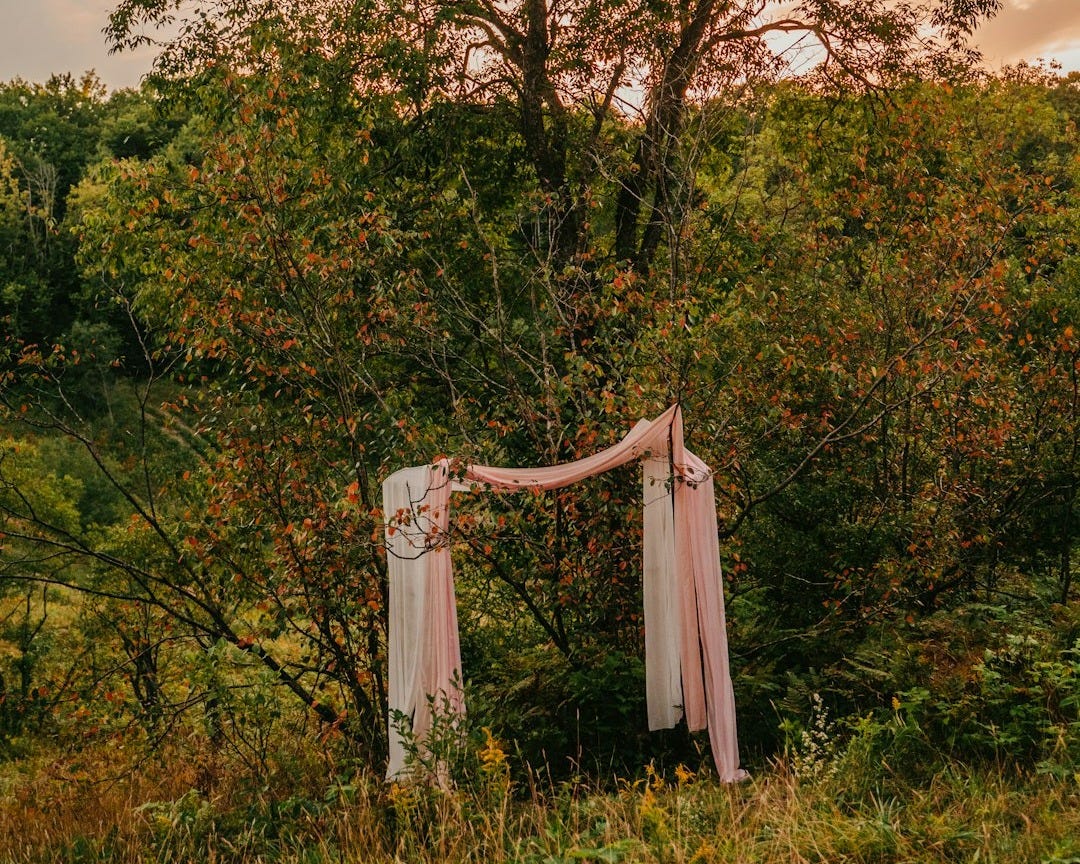
For all these things that the Taylor + Travis wedding gets right about rituals, there’s one thing it gets wrong: rituals don’t need to be huge, complex, expensive extravaganzas. If anything, such ordeals turn people off—and are rapidly losing favor.
When I was in Las Vegas, I met McKenzi Taylor, the founder of Cactus Collective, a leading wedding planner in the Wedding Capital of the World. She told me that the number of weddings has steadily dropped in the Las Vegas since 2000, settling around 50 percent of its peak. The size of weddings has also plummeted. When she started her business in 2016, 80 percent of weddings had more than fifty guests while 20 percent had under, a category known as microweddings; a decade later that percentage had flipped.
“Millennials changed everything. They get married later, which means they’re more independent. They want to pay for their own weddings, write their own vows, invite and their own friends. They tell their parents, ‘Butt out!’”
Taylor and Travis subtly nod to this point; their applications call for an intimate gathering of 100 people on the first day of their gathering, followed by a party for up to 999 on the second day. Even they realize the absurdity of one of the most meaningful occasions of their lives being held exclusively in an arena full of onlookers.
So even if their celebration is being planned by armies of professionals, their more intimate nuptial ceremony is a reminder that you don’t need gobs of money or teams of bouncers to mark a meaningful milestone in your life. Microgatherings can have macropower. Today we need rituals more than ever, even if it means having fewer people than ever.
🌞
Thank you for reading The Nonlinear Life. This is a reader-supported newsletter. You can support my work by ordering a copy of A Time to Gather or any of my other books. Click on the photo below to learn more.

Meanwhile, help us grow our community by subscribing, sharing, and commenting below. And you might enjoy reading these posts:
My CBS Mornings Interview about A TIME TO GATHER!
Pope Leo Calls for Human Gatherings to Counter AI
How Rituals Can Save Your Family — and the First Review of A TIME TO GATHER!
The Stories That Bind Us: My Most Popular Piece Ever
A Sudden Loss, A Missed Goodbye, A Lesson on How to Gather in Crisis
Or, you can contact me directly.